
The Potential and Challenges of Vertical Farming with Respect to Sustainability
Table of Contents
- 1 Introduction: Why Vertical Farming Is Gaining Attention
- 2 Overview and Key Characteristics of Vertical Farming
- 3 Types of Vertical Farming
- 4 Advantages and Challenges of Vertical Farming
- 5 Expansion of Commercial Vertical Farming: Case Studies
- 6 Conclusion: Implications for Evaluating Businesses’ Environmental Impact Reduction Efforts
Introduction: Why Vertical Farming Is Gaining Attention
The United Nations has announced that the global population has reached 8 billion and warns that, as it increases to 9.8 billion by 2050, the number of people facing hunger will rise even further (*1).
According to The State of Food Security and Nutrition in the World (SOFI) Report, an estimated 638 million to 720 million people—equivalent to 7.8% to 8.8% of the global population—faced hunger in 2024 (*2).
In addition, factors such as extreme weather, overcultivation, and soil erosion are steadily reducing the amount of land available for agriculture. Modern agriculture places a heavy burden on the environment and is considered a major source of greenhouse gas emissions. It is also regarded as a contributing factor to environmental degradation, including the loss of tropical rainforests, desertification, and the disappearance of lakes.
Against this backdrop of growing food demand and the need to reduce agriculture’s environmental impact, interest in sustainable agriculture has increased. One such approach is vertical farming, a method in which crops are grown in multiple stacked layers in the vertical direction. Compared with conventional open-field or greenhouse cultivation, vertical farming is expected to enable stable production of larger quantities of food using less land, water, and pesticides. The global vertical farming market is estimated at USD 8.15 billion in 2024 and is projected to reach USD 49.25 billion by 2033 (*3).
Overview and Key Characteristics of Vertical Farming
Vertical farming is an agricultural method in which crops are grown not in open fields but in vertically stacked structures such as shipping containers, using advanced AI and IT technologies. From the perspectives of cost and ease of cultivation, leafy vegetables such as lettuce and cabbage are most commonly grown, accounting for 57% of all vertical farming crops. Herbs and strawberries are also cultivated using vertical farming methods (*4).
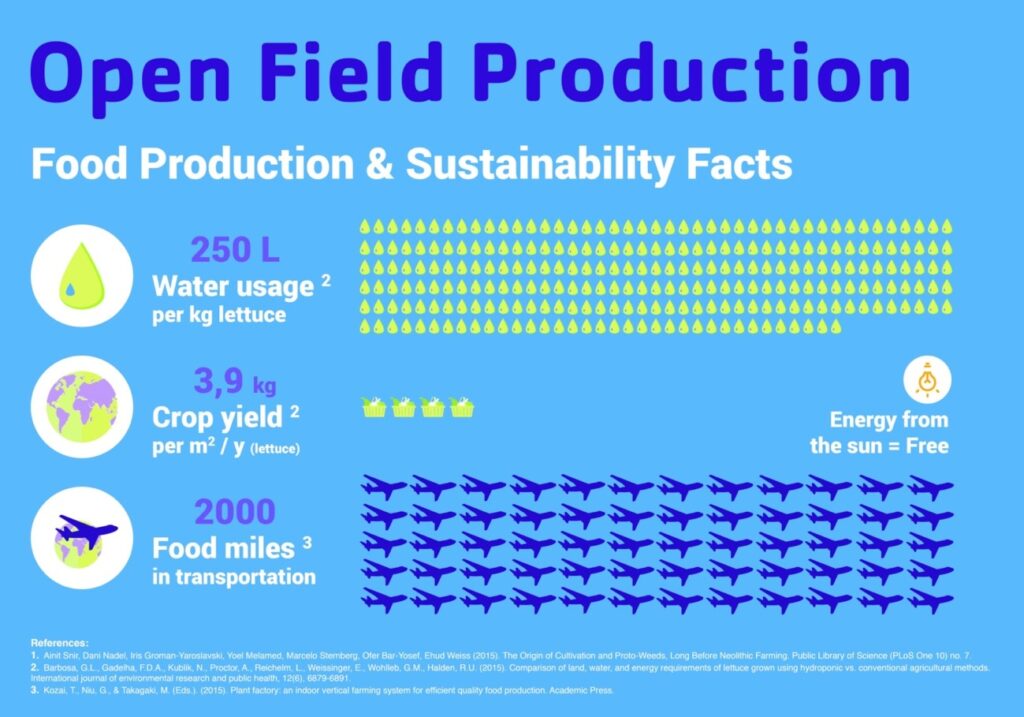
By leveraging technology to precisely control temperature, humidity, light, and irrigation, vertical farming has been reported to achieve higher yields per unit area than open-field cultivation. For example, the yield of lettuce is reported to an average of 60–105 kg per square meter under vertical farming(*5), compared with approximately 3.9 kg per square meter in open-field cultivation(*6).
Types of Vertical Farming
Classification by Structure
Vertical farming is commonly conducted in high-rise buildings, warehouses, or greenhouses and is sometimes collectively referred to as “plant factories.” Based on cultivation structure, it can be divided into two main types:
① Artificial-light-based systems: Plants are grown in enclosed indoor environments with controlled temperature and humidity. Recent studies using LED lighting have shown that the color and intensity of light can alter flavor and nutritional content (*7).
② Natural-light-based systems: These systems are not fully enclosed and incorporate natural sunlight, such as rooftop farms on high-rise buildings. They can be introduced at a lower initial cost than artificial-light-based systems.
Classification by Cultivation Mechanism
Based on cultivation processes, vertical farming can be broadly categorized into three types: hydroponics, aquaponics, and aeroponics.
① Hydroponics
Hydroponics is a cultivation method in which plant roots are immersed in water and liquid nutrients without using soil, while photosynthesis is induced using LED lighting (see Figure 1).
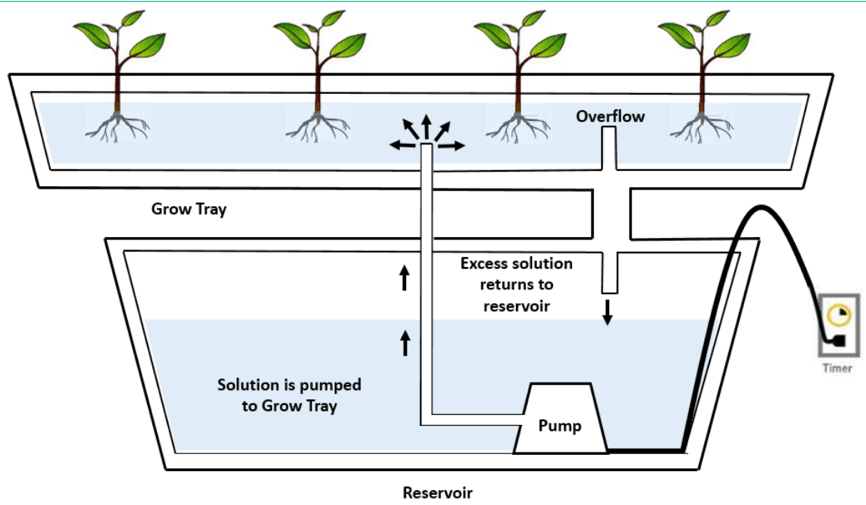
Figure 1
②Aquaponics
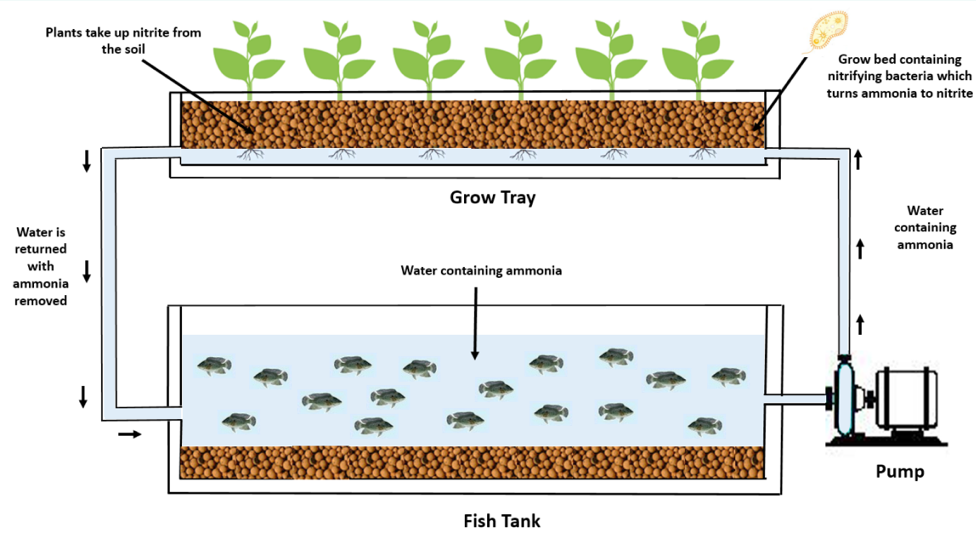
Aquaponics is a newly developed circular organic farming system that combines hydroponics and aquaculture (see Figure 2).
Figure 2
<source>
③Aeroponics
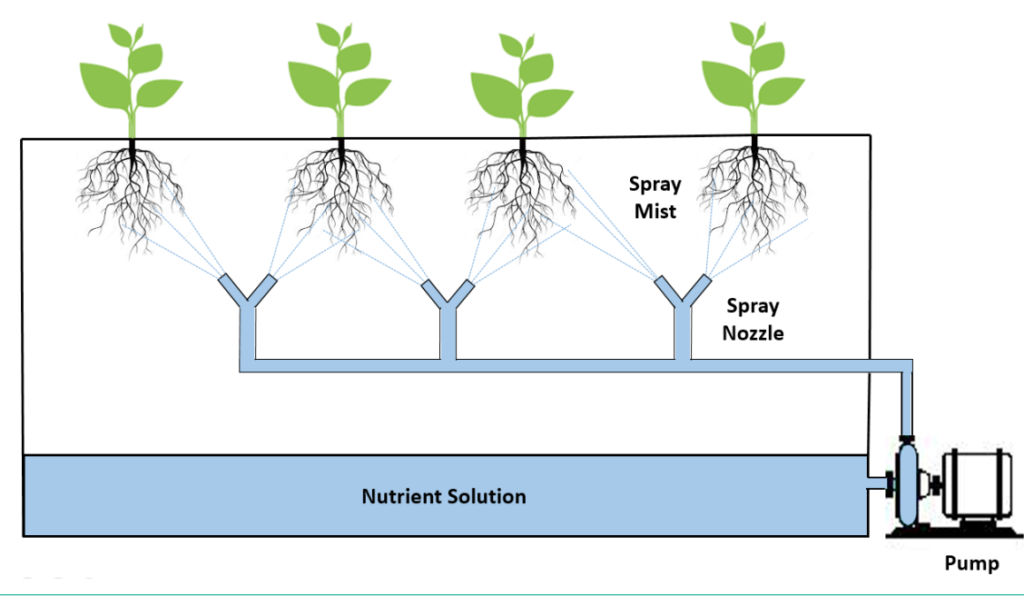
In aeroponics, plant roots are suspended in the air and supplied with nutrients by directly spraying liquid fertilizer onto the roots (*8) (see Figure 3).
Because irrigation and fertilizer application can be precisely controlled, crops grown using aeroponics are rich in minerals and vitamins. This method can reduce water use by up to 90% and fertilizer use by 60%, while increasing yields from 45% to as much as 75%, making it the most efficient cultivation method among vertical farming approaches (*9).
The global aeroponics market is projected to reach USD 3.92 billion in 2025 and is expected to grow to USD 24.27 billion by 2035.(*10)
Figure 3
<source>
Advantages and Challenges of Vertical Farming
This section introduces the advantages and challenges of vertical farming from five perspectives.
(1) Food Security
<Advantages>
The greatest advantage of vertical farming is its ability to provide a stable food supply regardless of season or weather. It is expected to mitigate yield instability caused by global warming and climate change, enabling stable production and employment.
Vertical farming has also attracted attention as a response to geopolitical supply chain risks, such as those exposed by the COVID-19 pandemic and Russia’s invasion of Ukraine.
<Challenges>
One challenge related to food security is the limited range of crops that can be commercialized. Due to production costs and sales prices, the current vertical farming market focuses primarily on leafy vegetables and fruits, making it difficult to grow all types of crops.
Another challenge is enormous amounts of energy consumption. Artificial-light-based systems, in particular, require electricity throughout all processes, including lighting, temperature control, sensors, and digital management systems. Photosynthesis and pollination, which occur naturally outdoors, must be artificially replicated, resulting in much higher energy consumption than greenhouse cultivation. (*11)Accordingly, building systems that enable self-sufficient energy use through renewable or surplus energy has become a key future challenge.
A third challenge is price instability. Rising global energy prices and inflation increase electricity costs for vertical farming, raising the likelihood that higher production costs will be passed on to consumers (*12).
(2) Carbon Footprint (Greenhouse Gas Emissions)(*13)
<Advantages>
A carbon footprint refers to the total CO₂ emissions generated throughout a product’s entire life cycle, from production and distribution to disposal. Generally, the longer the distance between production and consumption sites, the greater the greenhouse gas emissions from transportation. For example, transporting 1 kg of lettuce over 1 km is estimated to emit approximately 0.71 ± 0.41 g of CO₂. Vertical farming enables production and sales in large cities, allowing fresh vegetables to be delivered to consumers using less fuel, thereby reducing carbon footprints.
In addition, the proportion of crops lost or wasted along the supply chain is reported to be 4–9% for vertical farming, compared with 14–26% for open-field cultivation. This suggests that vertical farming reduces “wasted” energy use and greenhouse gas emissions.
<Challenges>
As noted earlier, vertical farming requires far more energy than open-field cultivation, leading to higher greenhouse gas emissions during energy generation. For example, the average greenhouse gas emissions per kilogram of fresh lettuce are estimated at 0.176 ± 0.02 kg CO₂-equivalent for open-field cultivation, compared with 2.87 ± 0.38 kg CO₂-equivalent for vertical farming.
However, these emissions vary greatly depending on whether the energy used is derived from fossil fuels or renewable sources. Therefore, the introduction of renewable energy is crucial for reducing the carbon footprint of vertical farming.
(3) Chemical Pesticides
<Advantages>
In conventional agriculture, chemical pesticides used to control pests may remain in soil or reach surface and groundwater depending on their chemical properties and environmental conditions (*14), raising concerns about residues on crops and adverse effects on aquatic organisms (*15).
In contrast, because vertical farming is conducted indoors with minimal pest presence, crops can be grown without pesticides. Previous studies have found no significant differences in nutritional value or taste between pesticide-free and conventional crops, although pesticide-free crops do contain fewer residues. (*16)
Moreover, pesticide-free crops tend to provide consumers with greater psychological reassurance, allowing businesses to sell them as higher value-added products. (*17)
(4) Water Use
<Advantages>
Vertical farming can reduce water use by approximately 90% compared with conventional agriculture (*18). Given that about 70% of global freshwater withdrawals are used for agriculture (*19), this is a critical factor in conserving valuable water resources. As such, vertical farming is attracting attention as a potential solution to global water scarcity driven by rapid population growth and water pollution.
For example, while conventional agriculture requires approximately 250 liters of water to produce 1 kg of lettuce, vertical farming has achieved the same output using only 1 liter of water (*20).
<source>
https://www.eitfood.eu/blog/is-vertical-farming-really-sustainable
(5) Environmental Certification
(a) Organic Certification
<Challenges>
Although vertical farming is environmentally friendly, it may not qualify for environmental certifications in some countries or regions. Organic certification is widely used to communicate producers’ environmental efforts to consumers, but whether the term “organic” can be used is regulated by law on a country-by-country basis.
A key point of divergence arises in the treatment of hydroponic cultivation, which does not use soil, leading to significant differences across countries in whether it qualifies as organic. For example, the United States has permitted the use of “organic” labeling for hydroponic cultivation since 2018 (*21), whereas the EU does not recognize hydroponic farming as organic (*22). As a result, there is currently a gap between the environmental contributions of vertical farming and consumer recognition of those contributions.
Expansion of Commercial Vertical Farming: Case Studies
With technological development and advancement, vertical farming has expanded from experimental scales to commercial operations, and plant factories are now being deployed worldwide. This article introduces primarily overseas examples.
① Gotham Greens (*23) (*24)
Gotham Greens is a New York–based urban agriculture company operating controlled environment agriculture (CEA) using rooftop greenhouses. Founded in 2009, it built the first commercial-scale rooftop greenhouse in the United States in 2011. Today, the company operates large-scale greenhouse farms in major metropolitan areas such as New York and Chicago, establishing a regionally integrated production system.
Its latest greenhouses are advanced, data-driven climate control facilities. Leveraging machine learning and data analytics, the company monitors crop health and growth conditions. Focusing primarily on leafy greens and herbs, Gotham Greens can deliver produce to urban consumers immediately after harvesting, ensuring exceptional freshness. Its products are sold through major U.S. supermarket chains and local retailers.
② Urban Crop Solutions(*25)
Urban Crop Solutions is a Belgium-based provider of indoor vertical farming solutions. Founded in 2014, the company integrates factory engineering and plant biology to design, manufacture, and implement turnkey indoor vertical hydroponic systems. Based on extensive empirical data from its research center, Urban Crop Solutions supports customers in selecting optimal crop varieties and growth algorithms, designs and installs automated plant factories and research facilities, and provides hands-on support during harvest.
The company has also developed customized indoor farming systems for sustainable microalgae cultivation, enabling the production of high-protein animal feed while reducing environmental impact.
③ Oishii Farm(*26)(*27)(*28)
Oishii Farm is New York’s first plant factory startup led by a Japanese CEO. The company completed a USD 50 million Series A funding round in 2021 and a USD 150 million Series B round in 2024. Drawing on Japan’s traditional greenhouse horticulture techniques, Oishii Farm operates vertical strawberry plant factories. Its flagship products are “The Omakase Berry” and “The Koyo Berry.”
Strawberries have traditionally been considered difficult to cultivate due to their need for pollination and long growing cycles. Oishii Farm became the first in the world to successfully achieve natural pollination by bees within a plant factory and realized stable mass production through its proprietary automated climate control system.
“The Omakase Berry” gained popularity after being introduced to Michelin-starred restaurants in 2018 and has since earned overwhelming support from top-tier restaurants and gourmet consumers.
In 2024, the company launched one of the world’s largest strawberry plant factories, the “Mega Farm,” in New Jersey, USA. Built by repurposing a former plastic factory and spanning 22,000 square meters—equivalent to more than three soccer fields—the facility uses no agricultural land, achieves completely pesticide-free cultivation by preventing pest and pathogen intrusion, and utilizes green energy generated by an adjacent solar power plant.
Conclusion: Implications for Evaluating Businesses’ Environmental Impact Reduction Efforts
As discussed, vertical farming has attracted attention as one option for stable food production that reduces water and pesticide use compared with traditional agriculture, while also offering resilience to climate change and geopolitical risks.
At the same time, depending on how it is implemented, vertical farming does not always result in environmental benefits. Existing systems involve massive energy consumption and high capital costs, and the range of cultivable crops remains limited.
To enable scientifically grounded evaluation of environmental contributions, our company has developed My Eco Ruler, a service that visualizes food sustainability. My-Eco-Ruler evaluates and scores the environmental impact of products based on Life Cycle Assessment (LCA), covering the entire lifecycle from production to transportation and consumption. By making corporate environmental initiatives visible and easy to understand, it helps convey clear information to consumers.
Obtaining LCA-based evaluations allows companies to understand the environmental positioning of their products in the food market and communicate comparisons with competing products.
For further information about My-Eco-Ruler, please contact “cuoncrop”.
cuoncrop ESG Global Trend Research Division
References
(*1)https://blogs.worldbank.org/en/opendata/world-population-day–trends-and-demographic-changes
(*2)https://www.wfp.org/publications/state-food-security-and-nutrition-world-sofi-report
(*3) https://www.grandviewresearch.com/industry-analysis/vertical-farming-market
(*4)https://www.cengn.ca/information-centre/innovation/vertical-farming-the-future-of-agriculture/
(*5) https://link.springer.com/article/10.1007/s13593-025-01055-w
(*7)https://www.mdpi.com/2673-9976/16/1/24/pdf
(*8)https://prtimes.jp/main/html/rd/p/000001004.000067400.html
(*9)https://www.infosys.com/industries/agriculture/insights/documents/vertical-farming-information-communication.pdf
(*11) https://www.sciencedirect.com/science/article/pii/S0959652624018079#sec3
(*12)https://www.lettusgrow.com/blog/vertical-farming-energy-crisis
(*13) https://link.springer.com/article/10.1007/s13593-025-01055-w
(*15) https://www.naro.go.jp/publicity_report/press/laboratory/niaes/154634.html
(*17) https://pubmed.ncbi.nlm.nih.gov/33794258/
(*20) https://www.sciencedirect.com/science/article/abs/pii/S0308521X17307151
(*22) https://www.europarl.europa.eu/doceo/document/E-9-2022-002588_EN.html
(*23) https://techweek.com/gotham-greens-newyork-urban-farming/
(*24) https://www.gothamgreens.com/our-story/
(*25) https://urbancropsolutions.com/
(*26) https://oishii.com/?srsltid=AfmBOooBv8cuG45Kpfwz7ylGTKfiln6M3anXVx27xNG39BEm8TuiLN_M